The Fourth Industrial Revolution, often referred to as Industry 4.0, is reshaping the landscape of manufacturing and various other industries. At its core, Industry 4.0 is about the convergence of technologies like Artificial Intelligence (AI), the Internet of Things (IoT), and automation. This synergy is not just changing the way businesses operate but also revolutionizing entire sectors. In this blog, we will delve into the key components of Industry 4.0 and explore how AI, IoT, and automation are working together to drive this transformation.
Understanding Industry 4.0
Industry 4.0 represents a paradigm shift in manufacturing and production. It builds upon the three previous industrial revolutions: mechanization, electrification, and computerization. This fourth wave is characterized by the fusion of physical systems with digital intelligence, creating a smart, interconnected, and highly efficient ecosystem.
- The Role of IoT (Internet of Things) IoT is the foundation of Industry 4.0, enabling the seamless communication between machines, devices, and systems. Sensors and actuators embedded in physical objects collect and transmit data to the cloud, where it is processed and analyzed in real-time. This connectivity allows for remote monitoring, predictive maintenance, and a deeper understanding of operations. For instance, in manufacturing, IoT sensors can monitor equipment performance, detect anomalies, and preemptively schedule maintenance. This not only reduces downtime but also prevents costly breakdowns.
- The Power of AI (Artificial Intelligence) AI brings intelligence to the massive amount of data generated by IoT devices. Machine learning algorithms can analyze this data, identify patterns, and make informed decisions. In the context of Industry 4.0, AI is used for predictive maintenance, quality control, demand forecasting, and more. AI-driven predictive maintenance, for example, can anticipate when a machine is likely to fail based on historical data and sensor readings. This allows for timely repairs, minimizing disruptions and reducing maintenance costs.
- Automation and Robotics Automation is the physical manifestation of the digital intelligence provided by IoT and AI. Robotics and automation systems are integrated into the manufacturing process to perform tasks that were once reliant on human labor. These machines work tirelessly, consistently, and without fatigue. Collaborative robots (cobots) are increasingly used in manufacturing to work alongside humans, enhancing efficiency and precision. They can handle repetitive tasks, freeing up human workers to focus on more complex and creative aspects of their jobs.
Synergy in Action
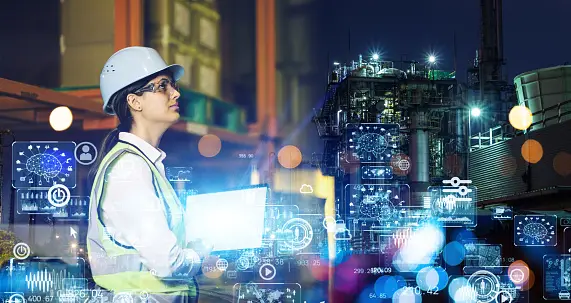
Let’s consider a practical example of how these three pillars of Industry 4.0 work together:
Smart Factory:
Imagine a smart factory that produces consumer electronics. In this factory:
- IoT sensors are embedded in machines, assembly lines, and even the products themselves. They monitor equipment performance, environmental conditions, and product quality in real-time.
- AI algorithms analyze the data from these sensors. They can detect when a machine is operating outside its optimal range or when a product has a defect. AI can also predict when maintenance is required.
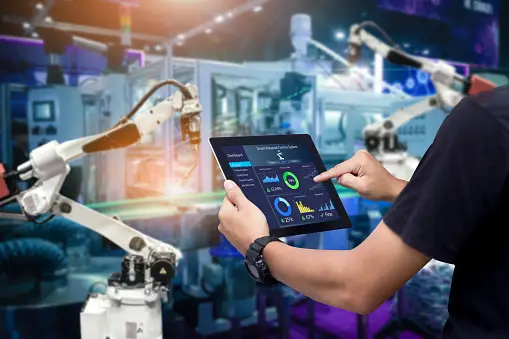
- Automation systems control the entire manufacturing process. Robots assemble components, guided by AI algorithms that ensure precision. When a machine needs maintenance, it’s scheduled at the most convenient time to minimize disruption.
Benefits of Industry 4.0
The synergy between AI, IoT, and automation in Industry 4.0 offers numerous benefits:
- Increased Efficiency: Operations are optimized for maximum efficiency, reducing waste and costs.
- Improved Quality: AI-driven quality control ensures that products meet high standards.
- Cost Reduction: Predictive maintenance reduces downtime and extends the lifespan of machinery.
- Greater Flexibility: Automation allows for rapid reconfiguration of production lines to adapt to changing demands.
- Enhanced Safety: Dangerous and repetitive tasks are handed over to robots, reducing the risk of accidents.
Conclusion
Industry 4.0 is not just about automation or AI or IoT in isolation; it’s about the powerful synergy that emerges when these technologies come together. This synergy is reshaping industries, making them smarter, more efficient, and more adaptable. As businesses embrace Industry 4.0, they will unlock new levels of productivity and innovation, ultimately shaping the future of manufacturing and beyond.
 EliteExtant
You must be logged in to post a comment.